ARC-AGI-3 · 25-game public evaluation · no training, no demonstrations
OPINE-World: programmatic world models, learned online from raw interaction
A single scored run per game. Two cooperating LLM agents play an unknown game from raw 64×64 frames,
write its dynamics as a Python program, admit the program only when it replays all observed transitions exactly,
and steer exploration by a Bayesian measure of object-type adequacy we call ontology error.
David Courtis · Wenhao Li · Scott Sanner
· University of Toronto, D3M Lab
gradient updates, demonstrations, or per-game engineering
Results · score vs levels cleared
ARC-AGI-3 scores a run by how few actions it spends against a per-level human baseline, so the score rewards clearing games and clearing them efficiently. OPINE-World reaches a mean score of
78.4 and wins 20 of 25 games.
Frontier-LLM baselines are the official single-run sessions published per task at arcprize.org
(fetched 2026-07-11, mirrored in assets/arcprize_baselines.json).
Method · hypothesis, test, repair
An object-centric world model, synthesized as code, verified by exact replay
01 · THE LOOP
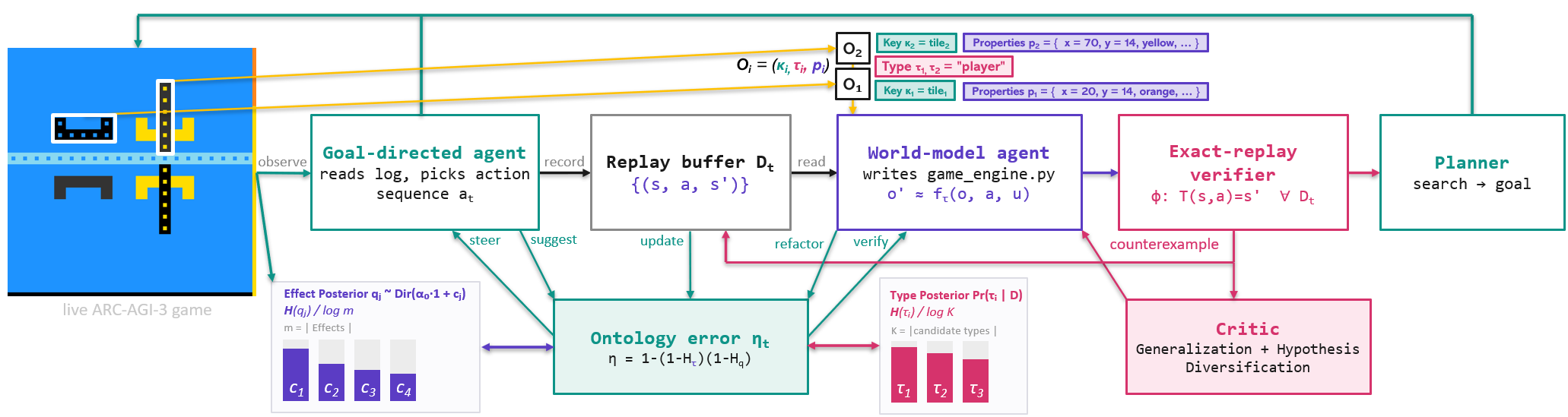
Two agents, a shared replay buffer, an exact-replay verifier
Game transitions are recorded into a buffer
Dt= {(s, a, s′)}.
A goal-directed agent reads the log and picks the next action sequence. A world-model agent reads the same buffer and
writes the dynamics as a Python program:
o′≈fτ(o, a, u),
one rule per type τ in local context u.
A candidate engine T̂ is admitted when
T̂(s, a) =s′ for every (s, a, s′) ∈Dt
acceptance is exact replay of the buffer, a misprediction is a counterexample and the trigger for a rewrite
A rejected proposal's mispredicted transition becomes the counterexample for the next round. After the first level
clear, a planner searches the verified program, validating planned steps against the live game.
02 · OBJECTS AND EFFECTS
States are objects, changes are abstract effects
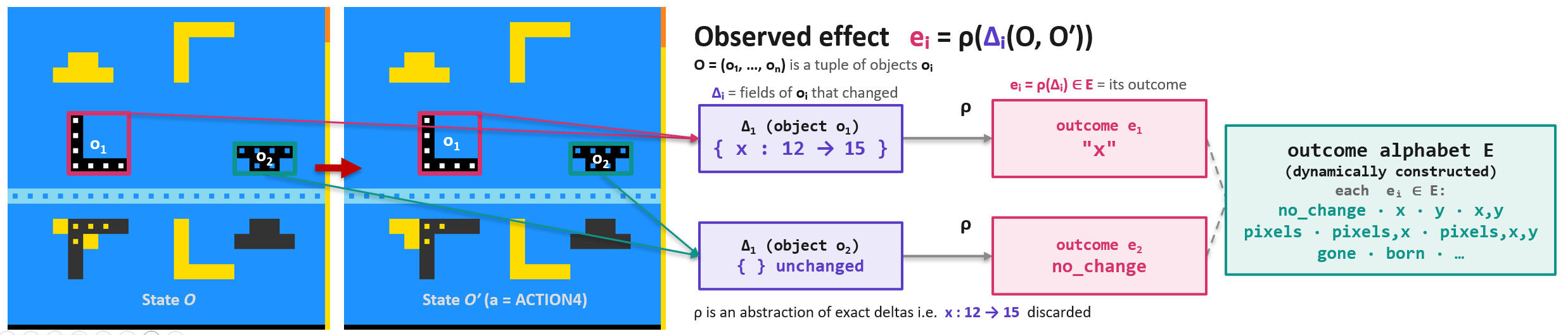
A state is a tuple of objects O= (o1, …, on),
and each object oi= (κi, τi, pi)
carries a tracking key κi, an inferred type
τi, and properties pi (position, pixel pattern).
The extractor producing these is itself synthesized from the raw 64×64 grids. Under action
a, the changed fields of oi form its delta
Δi, and the observed effect keeps the shape of the change
ei=ρ(Δi(O, O′))
ρ discards magnitudes, x : 12 → 15 becomes "x", making outcomes comparable across objects and levels
The outcome alphabet E grows from observation:
no_change · x · y · pixels · gone · born. A few transitions
suffice to show that two objects respond alike, the signal the type layer uses.
03 · ROWS AND CONTEXTS
Effect rows keyed by type, action, and local context
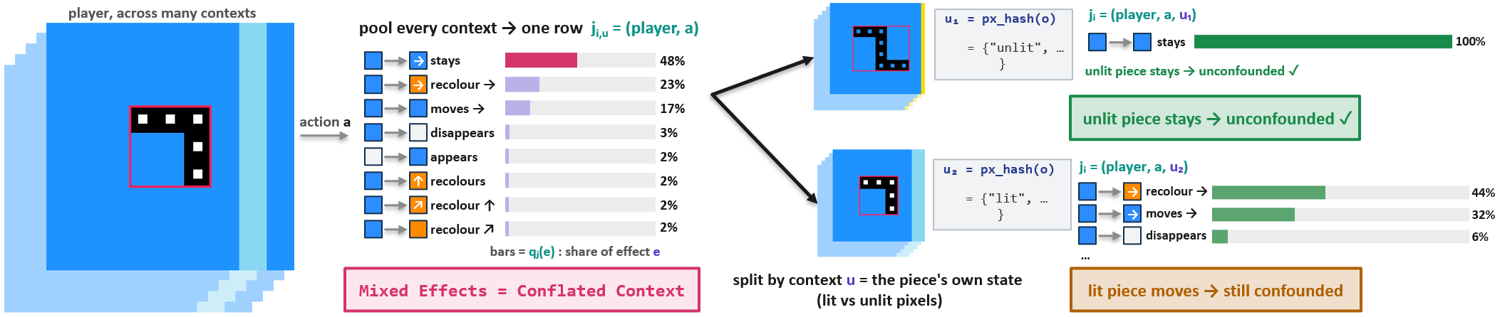
Object-transitions are filed into rows keyed by type, action, and local context,
j= (τ, a, u).
Row counts cj(e) with a symmetric Dirichlet prior give a
posterior over the row's effect distribution
qj∼ Dir(α0·1+cj)
α0 is a small pseudocount per effect, sparse rows remain uncertain, and the posterior is closed form
A row that remains mixed after many samples indicates a conflated context: a piece both "stays" and "recolours"
under one action because a hidden condition, its lit or unlit pixel state, was pooled away. Splitting on that context
u separates the mixture into near-pure rows, implementable as per-type rules
fτ. The Dirichlet form gives calibrated uncertainty from small counts without
fitting.
04 · ONTOLOGY ERROR
Ontology error η: joint type and effect uncertainty
Two normalized entropies measure what is unresolved: type uncertainty
H(τi) / log K from the posterior
Pr(τi | D) over K candidate types, and effect
uncertainty H(qj) / log m, with
m the number of observed effects. Both lie in [0, 1]. Ontology error combines them
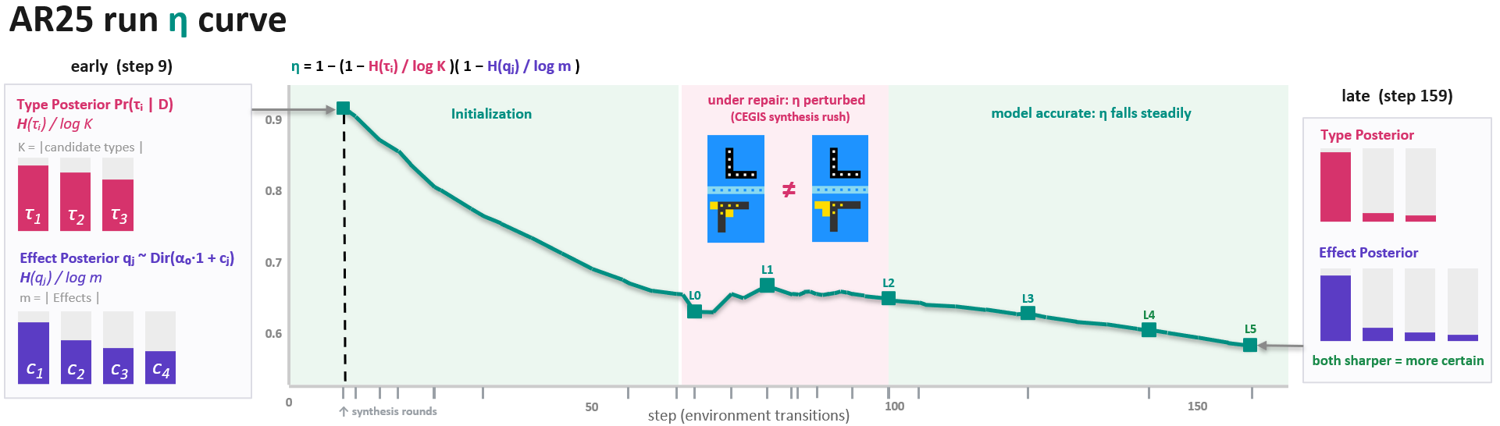
η= 1 − (1 −H(τi)log K)(1 −H(qj)log m)
the product form drives η to 0 when both type and effects are resolved, and either uncertainty keeps it high
Exploration is prioritized toward high-η rows, where the model mispredicts, rather than
re-deriving known dynamics. Over a run the curve falls as posteriors sharpen, is perturbed during CEGIS repair, and
declines once the engine replays the buffer. The annotated curve below is the ar25 run.
Observations · what the run artifacts show
01 · η ACROSS ALL 25 GAMES
η trajectories across the 25 runs
One line per run, rescaled to its own η range and trace span, so the graph shows trajectory
shape. Hovering a game in the selector (tapping, on a touch screen) transitions the chart to absolute coordinates with level
breakpoints, synthesis events, and the run's ending. Three runs (ar25, tr87, vc33) recorded
η from a late-engaging extractor onward, after the ontology had settled, and are drawn faded.
wonerroredlevel cleared, η valued (on hover)synthesis event (on hover)hover = absolute η, rest = relative shape
02 · HYPOTHESIS → CODE
Four traced hypothesis-test episodes
Each case is reconstructed from the released artifacts: the acting agent states a mechanism hypothesis
(quoted verbatim from its decision log), probes it in the live game, a synthesis round turns it into engine code, and
the exact-replay verifier reports the accuracy. Clicking a case opens that moment in the replay.
03 · ANATOMY OF A SYNTHESIZED ENGINE
Inside a final world model
04 · CONTEXT ECONOMICS
Token accounting for the two-agent split
Replays · all 25 scored runs, from the released artifacts
Replays of all 25 scored runs, with per-step reasoning and engine state
Each card replays the scored run, including intermediate animation frames. The Reasoning tab follows
the playhead and shows the move set the acting agent chose at that step, with its rationale. The
Engine tab shows the synthesized world model as of that step. Diamonds on the timeline mark
synthesis rounds, and added lines are highlighted against the previous round.
Click a game to open its replay · dots are levels: filled = at or above 50% level score, gray = cleared slower, hollow = budget ended there
LEVELS VS ACTIONS
Levels cleared against cumulative actions, per game
Levels cleared against cumulative actions, as on the official task pages. Black is OPINE-World, gray
the human reference, light gray baseline1. A flat tail is budget spent on an uncleared level. Clicking a game opens its
replay.
OPINE-Worldhumanbaseline1
SCORE PER LEVEL
Per-level scores across all 183 levels
More area is better. A level scores min(1.15, (human/agent)²), where human and
agent are the number of actions the human baseline and the agent took to clear the level; uncleared
levels score 0. ARC-AGI-3 gives no extra credit for clearing a level in far fewer actions than the human (1.15 cap): OPINE-World beats the cap on 109 of its 160 cleared levels, often by large margins the score cannot reflect.
05 · EFFORT HEADROOM · estimate
Room for increased effort
Both agents ran Opus 4.8 at high, the third of five reasoning-effort tiers. With xhigh and max efforts, gains are expected. We show this against the measured scores for the recent frontiers, as unfortunately, we are unable to report our results for higher-effort tiers due to financial constraints.
BUDGET · effort vs performance
Running Opus 4.8 on max is expected to deliver significant gains.
Official per-task sessions at arcprize.org, levels cleared across the 25 games. Effort
raises Sol from 9 to 48 levels, with the top two tiers adding roughly 60% over high.
Anthropic recommends
max for this kind of work
(announcement).
ERRORS · hypothesizing recovered runs
Some promising runs that failed to win ran into API rate limits well before a 2000 move limit was reached. Due to the runtime and idle limitations of ARC-AGI-3's competition mode, this cut their solutions short.
As an upper bound, if each errored game is set to the average score of the rest of the games, our final score would be 92.1.
We expect our true score to reasonably lie between these ranges.
Citation
@misc{courtis2026opineworldprogrammaticworldmodeling,
  title={OPINE-World: Programmatic World Modeling with
         Ontology-error-Prioritized Interactive Exploration for ARC-AGI-3},
  author={David Courtis and Wenhao Li and Scott Sanner},
  year={2026},
  eprint={2607.01531},
  archivePrefix={arXiv},
  primaryClass={cs.AI},
  url={https://arxiv.org/abs/2607.01531},
}
Reasoning
Engine
Loading replay…
–
level clearedsynthesis round (click to inspect the engine)